











Individual Machines
RTV-A-SC
Automatic sealing unit for the fourth spacer corner (start / stop)
The LiSEC RTV-A-SC automatically seals the last open corner of an applied flexible spacer by means of self-adhesive aluminium foil. The machine is used directly after automatic spacer application and ensures a visually clean finish of the fourth corner. The system reduces the visible light gap in the corner area and supports a uniform appearance of the insulating glass unit.
How is the RTV-A-SC constructed?
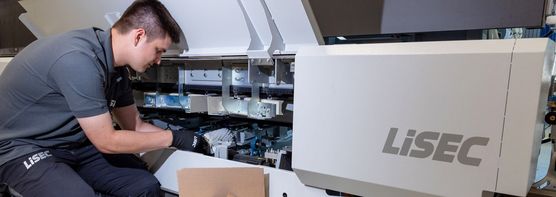
The machine is designed for use downstream of an automatic application station for flexible spacers. The glass is transported via transport rollers and a rear wall. The unit has an automatic cutting system for the aluminium foil, a release film winding unit and a vacuum holding system for fixing the insulating glass unit during the sealing process.
How does the sealing unit work?
After the insulating glass unit has been positioned by means of a glass stop, the corner to be sealed is fixed by a vacuum suction cup and supported from the inside. An aluminium strip is automatically cut to the required width.
The adhesive tape is then applied to one side of the last corner and tensioned over the open corner by means of a gripper. During this process, the integrated cleaning device continuously removes adhesive residues from the cutting blade to ensure a constant process sequence.
For whom is the machine for insulating glass processing suitable?
The RTV-A-SC is suitable for insulating glass manufacturers who process flexible spacer systems automatically and want to seal the last open corner of the spacer reproducibly. The machine is designed for use downstream of automatic application stations for flexible spacers.
- Automatic sealing of the last spacer corner
- Reduction of the visible light gap in the corner area
- Uniform and clean corner formation
- Automatic cutting of the sealing material
- Integrated cleaning of the cutting blade
- Automatic winding of the release film
- Easy integration into existing production lines
The Highlights
Visually clean fourth corner
The open corner of the flexible spacer is sealed by the automatic application of a self-adhesive aluminium foil. This creates a uniform appearance of the insulating glass unit.
Cleaning of the cutting blade
During operation, the cutting blade is continuously cleaned by a moistened sponge. This reduces adhesive residues and supports consistent cutting quality.
Exact positioning of the aluminium tape
The use of a rotating vacuum suction cup ensures that the portioned quantity is always matched exactly to the width of the spacer. The aluminium tape is then moved into the optimum position for application by a targeted rotational movement.